
How B2B keyword research differs from B2C
Traditional keyword research prioritizes volume to large part. B2B keyword research prioritizes pipeline potential, Onely notes in its 2026 guide to B2B SEO. The practical difference shows up in the numbers. Search Engine Journal shows the pattern at the tail: the B2C keyword “to-do list app” has 5,400 monthly searches according to Ahrefs, while the targeted B2B term “enterprise project management software” has 250, and some B2B keywords run as low as 10 to 50 searches per month.
The consequence for your keyword list is that it will look longer and flatter than a B2C list. More terms, each with smaller volume, each tied to a specific stage in a longer buying process. Onely reports that 70-80% of B2B searches are long-tail, three or more words, which is consistent with that shape.
The reason sits in the purchase itself
The difference is not in the keywords. It is in the purchase process. Forrester’s 2026 State of Business Buying finds that the typical buying decision now includes 13 internal stakeholders and nine external influencers, with that number rising for more complex or strategic purchases. Onely puts the B2B sales cycle at 84 days against 9 for B2C, with an average buying committee of 11 people versus 1-2.
The buyer is most of the way through before a vendor hears from them
Bain and Company and Google found that 92% of B2B buyers have a list of preferred vendors before they even begin their research. Konstruct Digital puts it more concretely: buyers are not clicking on ads or filling out forms until they are 70-80% through their decision process. By the time they raise their hand, they have already eliminated most potential vendors through anonymous research.
That is why the shortlist is shaped by research-phase terms. The keywords that matter are the ones typed before anyone talks to a sales team, and those are often low-volume, high-intent queries. Onely notes that success metrics shift from traffic to pipeline influence, which is the frame the rest of this post works in.
Volume is not value
A keyword with 20 monthly searches might be worth more than one with 2,000, Konstruct Digital points out. There is a very good chance that zero-volume keywords can lead to seven-figure deals.
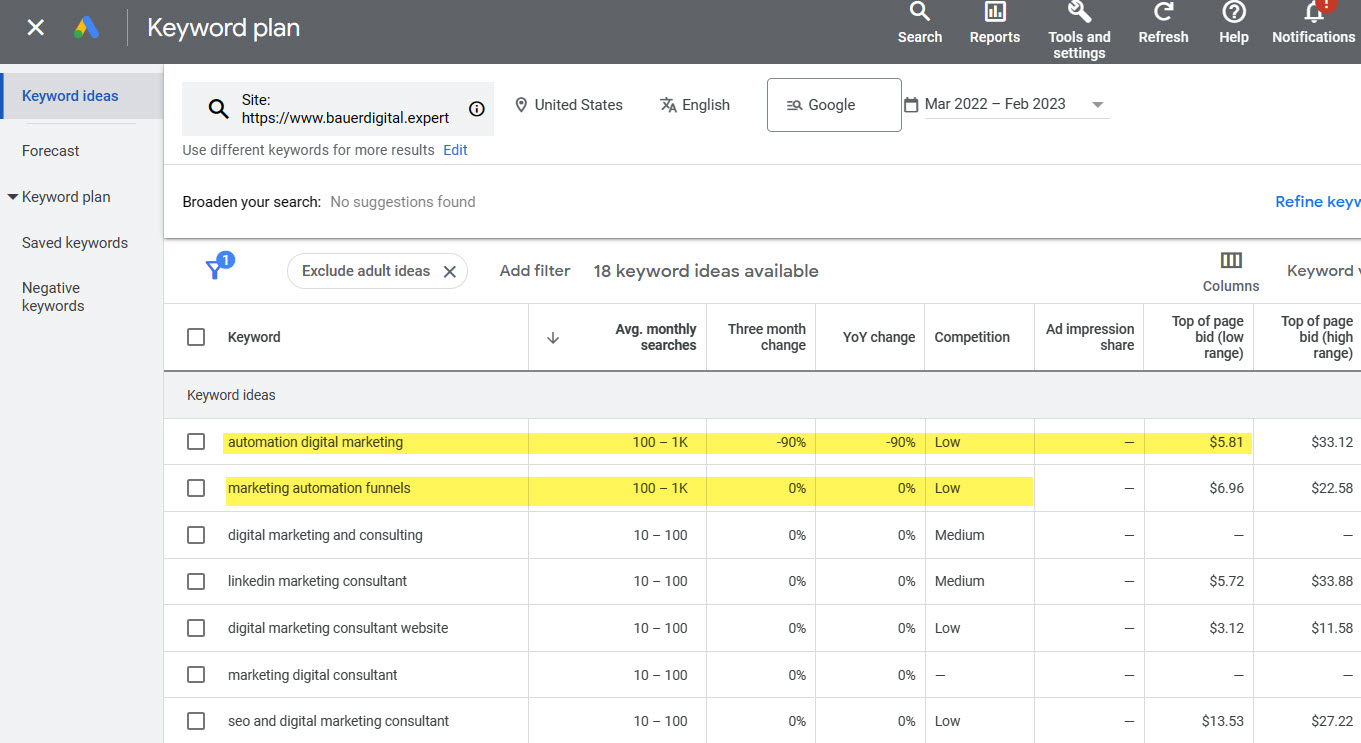
Google’s own documentation makes the same point from the tool side. Low search volume status in Keyword Planner does not mean nobody searches the term.
From my experience helping B2B focused clients with their search and content strategy, I find that low volume keywords often get overlooked because they have very minimal search volume, often keyword discovery tools do not even display them. Even so, these could be extremely high value keywords that carry much intent. This is again where the foundational work of documenting the buyer’s journey is so important. It is not a single person searching, it could be a technical lead, procurement, CTO or other executive, all trying to answer different questions because they have a different role in the buyer’s journey. Having an in-depth understanding of the buyer’s journey for your product or service is imperative to build content that increases visibility and has an impact on your sales pipeline.
Boris Bauer, founder of bauerDIGITAL
Which keyword structures matter at each buying stage
Konstruct Digital maps industrial buying through six stages: problem recognition, solution exploration, requirements development, vendor evaluation, consensus building, and selection. Each stage has distinct search behavior and drives different search terms. Moz’s buyer’s journey model maps keyword modifiers to user intent across three stages: awareness, consideration, and decision. Moz’s modifier list runs: what, how, where, who for awareness; [Brand] vs [Brand] reviews for consideration; and transactional modifiers for the decision stage.
The five stages below use the finer cut that fits B2B buying, with Moz’s modifier-to-intent mapping as the backbone.
| Stage | Keyword structure | Example query | Who searches it | Content type |
|---|---|---|---|---|
| Problem-aware | “how to [job]”, “why does [symptom]” | “why does my stamping press keep jamming” (Konstruct) | End user or technical buyer running the process | Explanatory article |
| Solution-aware | “[category] software for [industry/role]” | Illustrative | Champion and end user forming the shortlist | Comparison guide, use-case page |
| Vendor shortlist and comparison | “[tool] vs [tool]”, “[tool] alternatives” | “Okuma vs Mazak 5-axis machining centers” (Konstruct); “Salesforce vs HubSpot”, “Best video conference alternative to Zoom” (Ellipsis) | Technical evaluator and economic buyer | Comparison page |
| Pricing and purchase | “[tool] pricing” | “[tool] pricing” (the pattern carrying Onely’s conversion figure) | Economic buyer and procurement | Pricing page, ROI calculator |
| Implementation and post-purchase | “[tool] implementation”, “[tool] integration with [system]”, “[tool] SOC 2” | Illustrative | Technical buyer, IT, security, procurement | Integration page, security documentation |
The comparison and alternatives structures carry the strongest purchase signal in B2B SaaS. Ellipsis notes that the additional word “alternatives” signals purchase intent. Onely reports that bottom-funnel keywords like “[tool] pricing” convert at 8-12% to trials in B2B SaaS, outpacing top-funnel keywords by 4x.
Moz maps each stage to the content that answers it: explanatory content for awareness, explainer videos and comparison guides for consideration, and FAQ pages, case studies, and reviews for the decision stage. Gravitate Design frames the same progression at the asset level: blog posts and glossaries at the top of the funnel, comparison pages and use cases in the middle, and product demos, free trials, ROI calculators, pricing pages, and customer testimonials at the bottom. Onely adds that different stakeholders need different content: CFOs need ROI, IT needs security and integration, end users need features, procurement needs vendor qualification.
Who on the buying committee searches what
Different roles search in different language reflecting their role-specific concerns. Ellipsis gives the clearest example: a CTO might search for “enterprise data security compliance,” while a procurement manager searches for “data security software pricing comparison.” Konstruct Digital splits buyers into technical evaluators who focus on specifications and performance, and business buyers who focus on ROI, risk mitigation, and business outcomes. Influ2’s 2026 survey of 50 buyers found that budget approval (34%), internal alignment (22%), and security concerns (20%) are the top deal bottlenecks, and that IT and Security raise the biggest objections in 38% of deals.
Finding the terms a tool shows as 0-50
The practical problem: Keyword Planner is built for researching Google Ads keywords, so not all keywords are reported. Volume numbers are broad estimates, often aggregated, combining numbers for similar keywords. They are also rounded off. Volume reports have a time lag, so the tool is not useful for newer or up-and-coming keywords, Search Engine Journal notes. A reading of 0-50 is a tool reporting limit, not evidence that nobody searches the term.
Start before the tool. We recommend documenting pain points in customers’ exact words: pull verbatim phrases from sales call recordings, support tickets, and closed deal notes. These become seed keywords.
Deepen the seed list from customer-facing teams. The Gray Company quotes Onely’s recommendation to mine internal team knowledge: the questions your sales and support teams hear every day. If they reply by email, the answer is already partly written as well. Konstruct Digital adds CRM data and customer conversations: contact form questions, chat transcripts, and discovery call questions, often zero-volume keywords.
Then use Keyword Planner to size and cluster the terms you already have. To access it, sign into a Google Ads account and go to Tools, then Keyword Planner. Enter a seed keyword or your website URL to generate related terms with volume, competition, and cost per click. Use “Discover new keywords” to expand from a seed phrase, and “Find new keywords” to pull ideas from a website URL. Enter a list of keywords or upload a CSV to check search volume and forecasts. Review the search terms report to identify negative keywords, search terms that triggered your ads but are not relevant to your business. Add those to your negative keywords list so your ads stop showing for them.
Once you have terms in the planner, a few practical moves matter. Enter a seed keyword and sort by lowest volume and low keyword difficulty to surface more long-tail varieties than the default view shows. Use the refine keywords filters to strip out unrelated brand names or niche terms. Compare monthly search ranges across locations, for example New York versus the whole United States, to inform geo-targeted content decisions. Sort by the yearly searches column to spot rising queries before competition spikes. Input a competitor’s product URL instead of a generic keyword to see which terms that specific page already ranks for, then look for gaps. Use the integrated campaign forecasting tool to model how changing your CPC bids impacts estimated clicks and costs before launch.
The closing point: 15% of searches Google sees are entirely new each day, The Gray Company notes. A tool that lags behind new queries will under-count the terms your buyers are actually typing.
Measuring by pipeline, not traffic
Content Marketing Institute’s 2025 B2B research found that 56% of marketers say difficulty attributing ROI to content efforts, and the same number cite difficulty tracking customer journeys. One HubSpot Marketing Blog author describes the failure mode directly: early in his SEO career, he generated two million clicks for an ecommerce store and could not quantify a single sale from two million visitors.
The B2B context makes the problem sharper. Onely reports that B2B buyers consume 13 pieces of content before purchase against 3-5 for B2C, and that B2B conversion rates run at 2.1% against 3.3% for B2C. The same visitor is worth more but converts later and across more touchpoints. Gravitate Design reports, as a practitioner benchmark, that bottom-funnel assets like product comparisons, pricing pages, and ROI calculators typically convert 3-5 times better than purely educational content.
The same Content Marketing Institute study found that 92% of B2B teams use short articles and posts, 76% use videos, and 75% use case studies or customer stories. The teams rate videos (58%) as the most effective content type, followed by case studies and customer stories (53%). Clicks are a weaker proxy than they used to be: Google serves AI overviews in 47% of results, HubSpot notes, so part of the research phase now happens inside the search results page itself.
Measure influenced pipeline, not clicks. Track which stages of the buying journey your content serves, and whether the terms you target appear in the queries of buyers who eventually become customers.
Sources:
Onely, “B2B SEO”, February 26, 2026, https://www.onely.com/blog/b2b-seo
Search Engine Journal, “B2B Keyword Research”, undated, https://www.searchenginejournal.com/b2b-keyword-research/428962
Forrester, “Forrester 2026: The State of Business Buying”, 2026, https://www.forrester.com/press-newsroom/forrester-2026-the-state-of-business-buying
Ellipsis, “How to Analyze B2B Keywords for Business Impact”, undated, https://getellipsis.com/blog/b2b-keyword-research
Konstruct Digital, “B2B Keyword Research”, undated, https://www.konstructdigital.com/seo/b2b-keyword-research
Google Ads Help, “Low search volume: Definition”, undated, https://support.google.com/google-ads/answer/2616014
Moz Blog, “Buyer’s Journey and User Intent: Whiteboard Friday”, undated, https://moz.com/blog/buyers-journey-and-user-intent-whiteboard-friday
Gravitate Design, “B2B SaaS SEO”, April 29, 2025, https://www.gravitatedesign.com/blog/b2b-saas-seo-strategies
Influ2 Academy, “B2B Buying Committees”, March 20, 2026, https://www.influ2.com/academy/buying-committees
Search Engine Journal, “A Complete Guide to Keyword Search Volume for SEO”, undated, https://www.searchenginejournal.com/keyword-search-volume/421907
The Gray Company, “Working with Zero-Volume Keywords: A Research & Implementation Guide”, May 1, 2023, https://thegray.company/blog/zero-search-volume-keywords-research-implementation
Content Marketing Institute, “B2B Content Marketing: 2025 Benchmarks & Trends”, 2025, https://contentmarketinginstitute.com/b2b-research/b2b-content-marketing-trends-research-2025
HubSpot Marketing Blog, “How to use buyer journey keyword research to drive SEO-generated revenue”, April 30, 2025, https://blog.hubspot.com/marketing/buyer-journey-keywords