You’re Running Paid Media on Multiple Platforms. Nobody Is Managing How They Work Together.
Google Search captures intent. LinkedIn builds awareness with the right professional audience. Meta retargets visitors who didn’t convert. OTT puts your brand in living rooms at a fraction of traditional TV costs. Programmatic extends reach across the open web with precision targeting.
Each channel has a role. The mistake most companies make is treating them as separate campaigns managed in separate conversations by separate teams. When channels don’t connect, budgets don’t compound. You pay to reach the same person multiple times on different platforms with no strategic thread between the touches.
We manage paid media as an integrated system, all channels feeding each other, audiences moving through a defined journey, every dollar working in the context of everything else.
We also only work with clients who let us manage that system completely. When someone else is running one channel while we run another, there are too many variables and too little alignment to produce results we’d put our name on.
Every Channel Has Its Own Plan.
None of Them Share One.
THE ALGORITHM PROBLEM NOBODY TELLS YOU ABOUT
Why Your Campaigns Underperform.
Pausing Them Makes It Worse
Every major paid media platform, Google, Meta, LinkedIn, runs on machine learning algorithms that need time and data to optimize. When a campaign launches, the algorithm enters a learning phase. It tests audiences, placements, creative combinations, and bidding strategies. Performance during this phase is deliberately inconsistent. That’s not a problem. That’s the process.
The problem happens when clients treat paid media like a light switch. A campaign launches, enters the learning phase, and as soon as the initiative it was supporting wraps up, it gets paused. No current need, no active campaign. Reasonable logic. But when the next initiative arrives and the campaign restarts, the algorithm treats it as a new campaign. The learning phase starts over. Performance dips. Budget gets questioned. The cycle repeats with every initiative. The conclusion becomes that paid media doesn’t work. The actual conclusion is that paid media was never given the continuity it needs to work.
We recommend always-on campaigns. Not because it protects our management fees, clients pay media platforms directly and we don’t mark up media spend. We recommend it because pausing campaigns is genuinely expensive in ways that don’t show up on the invoice.
When you have a promotional initiative, a product launch, or a seasonal push, we increase budget to support it. When it ends, we return to the baseline. The algorithm stays in its optimized state. Performance compounds rather than resetting every time the calendar changes.
This is one of the most important things we tell new clients. It’s not always what they want to hear.

Pausing Your Campaign to Save Budget Is One of the Most Expensive Decisions in Paid Media.
HOW THE CHANNELS WORK TOGETHER
The Integration Argument Most Paid Media Agencies Don’t Make Because They’re Only Running One Channel
Paid media channels don’t produce their best results in isolation. They produce them when each channel does the job it’s best suited for and hands the audience to the next channel at the right moment.
Here’s what that looks like in practice.
A LinkedIn content promotion reaches a precisely targeted professional audience, defined by job title, company size, industry, and seniority. Some click through to your site. Most don’t, but they’ve seen your brand in a professional context. That audience is now cookied and available for retargeting on Meta and Google.
Here’s the statistic some B2B marketers find surprising: LinkedIn’s own research shows a 92% audience overlap when retargeting LinkedIn audiences on Meta. The professionals you’re trying to reach on LinkedIn are on Facebook and Instagram too, but at a fraction of the cost per impression. We feel that B2B marketers who dismiss Meta as a consumer platform are leaving their most cost-effective retargeting channel unused because of a perception problem.
Meanwhile, Google Search captures the same audience at the moment they’re actively searching for solutions. Someone who saw your LinkedIn promotion last week and your Meta retargeting ad yesterday is now searching for the category you compete in. Your search ad appears with the advantage of two prior brand impressions. The conversion rate on that click is materially higher than it would have been on cold traffic.
Programmatic display extends reach across premium publisher inventory — the business news sites, industry publications, and professional content your audience reads — reinforcing the message across the full browsing context. OTT puts your brand on connected TV in the households of your target audience, on channels from CNN to ESPN to Hulu, for a fraction of what traditional television advertising costs.
Every channel contributes to a cumulative effect. Managed in isolation, each one performs adequately. Managed as a system, they compound.
Core Services
Google Search & Performance Max
Google Search can be the bottom of the funnel — the moment a prospect is actively looking for what you sell, or it can be at the very top of the funnel, where your prospect is researching and looking for a solution of their problem. Getting that moment right requires precise keyword strategy, match type discipline, negative keyword management, and landing page alignment that most campaigns compromise on in at least one of these areas.
Google Performance Max extends beyond search into display, YouTube, Gmail, and Maps through a single campaign structure driven by Google’s machine learning. When fed the right creative assets, audience signals, and conversion data, pMax expands reach efficiently across Google’s full inventory. When set up poorly, it becomes a black box spending budget on placements that don’t convert.
We build and manage Google campaigns with the strategic discipline that separates performance from spend implementing keyword architecture that captures genuine intent, bidding strategies calibrated to your actual conversion economics, and pMax configurations that give the algorithm the inputs it needs to optimize toward pipeline rather than clicks.
LinkedIn Is the Only Platform Where You Can Reach Your Exact Buyer by Job Title, Seniority, and Company Size.
Most Companies Use It to Boost Posts.
LinkedIn Promotion & Lead Ads
LinkedIn’s targeting precision is unmatched for B2B, the ability to reach a VP of Marketing at a manufacturing company with between 200 and 500 employees in a specific geography is not available at this level of accuracy anywhere else. That precision comes at a cost per click that can make marketers flinch.
The answer isn’t to spend less on LinkedIn. It’s to use LinkedIn for what it does best, precise professional audience targeting and brand building with the right people, and retarget that audience on cheaper platforms once the initial impression has been made.
We run LinkedIn content promotions that build awareness with precisely defined professional audiences, LinkedIn Lead Gen Forms that capture contact information without requiring a landing page click, and audience building strategies that feed the retargeting campaigns running on Meta and Google. LinkedIn is the top of the paid media funnel. Everything else builds on the audience it creates.
Meta — Facebook & Instagram
Meta’s reputation as a consumer platform causes B2B marketers to underinvest in it consistently. The 92% audience overlap with LinkedIn retargeting audiences tells a different story. The decision-makers you’re trying to reach professionally are the same people scrolling their personal feeds and reaching them there costs a fraction of what LinkedIn charges.
We use Meta primarily as a retargeting and nurture channel in B2B contexts by reinforcing messages with audiences who have already engaged with your LinkedIn content, visited your website, or interacted with your brand in other channels. The creative approach adapts to the context, less formal than LinkedIn, more visual, designed for the personal feed environment rather than the professional one.
For clients with ecommerce components or consumer-facing products alongside B2B offerings, Meta’s prospecting capabilities are also significantly more sophisticated than most advertisers utilize.
Your Brand Can Run on CNN, ESPN, and Hulu, In the Households of Your Target Audience, for a Fraction of What a Traditional TV Commercial Costs.
OTT — Connected TV
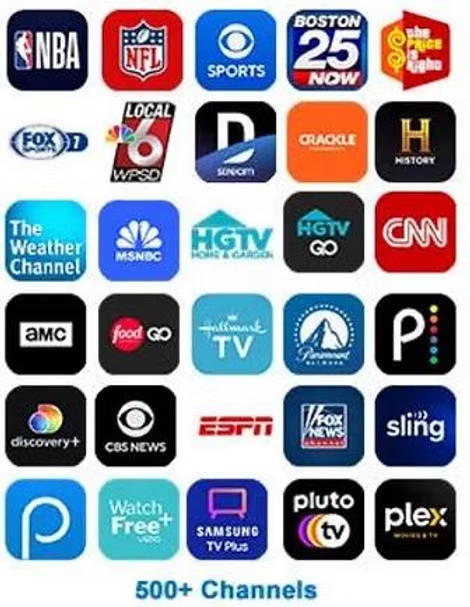
Over-the-top advertising delivers video ads through streaming platforms and connected TV devices, Hulu, Roku, Amazon Fire TV, and major network streaming apps including CNN, ESPN, and MSNBC. Your ad appears on the actual television screen in your prospect’s living room, at targeting precision traditional broadcast television never offered.
Traditional TV advertising required buying broad demographic audiences and paying for reach that extended well beyond your target market. OTT targets by household income, geography, interests, and, when combined with the audience data from your other campaigns, the specific professional profiles you’re already reaching on LinkedIn and Meta.
For B2B companies where brand awareness at the executive level matters, OTT delivers television-level presence at a budget accessible to companies who would never consider a traditional broadcast buy. It’s an awareness channel that reinforces every other channel in the mix.
Programmatic CAMPAIGNS
Programmatic advertising places display and video ads across premium publisher inventory through real-time bidding, targeting your defined audience wherever they browse rather than on a single platform. The business news sites, industry publications, and professional content your buyers read become part of your paid media footprint.
We use programmatic primarily as a reach extension and retargeting channel, keeping your brand present across the full browsing context of your target audience between their interactions with your LinkedIn, Meta, and Google campaigns. Audience segments built from your CRM data, website visitors, and platform engagement feed programmatic targeting, creating consistent brand presence across the open web.
HOW WE WORK
Senior Expertise. Transparent Reporting. No Black Boxes.
Every client engagement is managed by senior paid media specialists, not junior account coordinators relaying information between you and the people actually running your campaigns. The team managing your campaigns has the experience to make strategic decisions, explain the reasoning behind them, and have direct conversations about what’s working and what isn’t.
We meet regularly to review campaign performance together, sharing insights, explaining what the data is telling us, and consulting on actionable next steps rather than presenting a report and waiting for questions. During the launch and optimization phase, we meet more frequently. As campaigns stabilize and trust develops, some clients give us more latitude and prefer less frequent touchpoints. The cadence adapts to your preferences and the complexity your budget warrants.
Your media budget goes directly to the platforms. We don’t mark up media spend. Our fee covers strategy, management, optimization, and the senior expertise that makes the difference between campaigns that compound and campaigns that consume budget without building anything.
We also don’t work with clients who want us to manage one channel while another agency or internal team manages the others.
The integration between channels is where the performance lives. Splitting channel management between teams with different strategies, different reporting, and different optimization decisions produces exactly the disconnected paid media problem we described at the top of this page.
We manage the full system or we’re not the right partner.

PAID MEDIA CONNECTS TO THE FULL STACK
Paid Media Performs Best When It Has Something Worth Amplifying
A paid media campaign driving traffic to a poorly optimized landing page wastes every click. Content developed without a distribution strategy misses the amplification paid media provides. CRM data that doesn’t feed audience targeting leaves your most valuable retargeting segments unused.
We connect paid media to the rest of your marketing stack, crafting and consulting on landing page copy and conversion optimization. Organic content being is amplified through paid promotion, and campaign performance data returning to the CRM to inform lead scoring and sales follow-up.
Paid media without connected content, CRM data, and conversion infrastructure is a spending mechanism.
Connected to the full stack, it’s a compounding growth system.
START WITH A DIAGNOSTIC
We Assess Before We Recommend Channels or Budgets
We don’t recommend a paid media channel mix before understanding your current situation. What you’re running, what it’s producing, what your buyer journey looks like, and where does paid media fits in the context of your overall marketing stack.
The assessment examines your current campaign structure, platform configurations, audience targeting, creative approach, landing page performance, and CRM integration. We will identify what’s working, what’s wasting budget, and what’s missing from the channel mix entirely.
“We’re already running paid media with another agency.”
Most clients in this situation have campaigns that are technically running and strategically disconnected. Each channel is being managed to its own metrics with no integration between them. The LinkedIn agency doesn’t know what the Google agency is doing. Nobody is building audiences on one platform to retarget on another. The algorithm learning cycles are being disrupted by well-intentioned budget pauses that reset performance every time.
If your paid media spend isn’t producing pipeline you can trace let’s look at what’s actually running and whether the system is built to compound or just to spend.