
CASE STUDY
Datatrek
Client: Datatrek
Industry: Financial Publishing, Investment Newsletter
Services: WordPress Performance Optimization, Template Refactoring, Hosting Migration, Security Hardening, GDPR Compliance
Engagement Type: Technical website optimization, ongoing as needed
Datatrek delivers market analysis to international investors through a subscription newsletter. For a publisher whose business runs on credibility, the website is not a marketing asset in the traditional sense. It is the product’s front door. A slow or insecure site raises questions before a prospective subscriber reads a single word.

The Site Wasn’t Breaking Down. It Had Never Been Built to Perform.
What the Client Came In With
The original engagement was straightforward: basic site updates. Datatrek had no awareness of underlying performance issues. There were no subscriber complaints, no visible errors, no obvious signals that anything was wrong. The site was functioning. It was not performing.
That distinction only became visible when our team ran the numbers.
What the Assessment Revealed
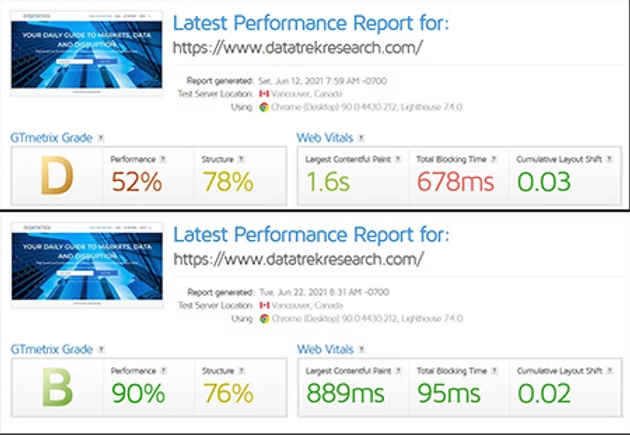
A review of Google Search Console and GTmetrix made the problem concrete. The site was scoring a GTmetrix grade of D. Largest Contentful Paint measured 1.6 seconds. Total blocking time was 678 milliseconds. These are not borderline results. They represent a site that search engines and users both experience as slow.
The root cause was layered. The original templates had been built with a page builder that added substantial unnecessary code, inflating load times and undermining Core Web Vitals performance. The hosting environment was generic and not configured for WordPress specifically. A GDPR compliance gap was identified and needed to be addressed. The site’s security configuration was the default WordPress setup, with no hardening applied.
None of this had been flagged before. It had simply never been looked at.
A Host Upgrade Alone Moved the Grade from D to B. The Template Work Made It Better Still.
What We Built
The hosting migration came first. Moving to a provider that specializes in WordPress produced an immediate, measurable result: GTmetrix grade improved from D to B, Largest Contentful Paint dropped from 1.6 seconds to 1.1 seconds, and total blocking time dropped from 678 milliseconds to 172 milliseconds. That was the impact of the host change alone, before any code work was done.
Template refactoring replaced the page builder with Gutenberg, WordPress’s native editor. Removing the page builder eliminated a significant layer of unnecessary code, improving load speed further and strengthening the site’s performance in organic search. GDPR compliance gaps were corrected. Security hardening was applied across the standard WordPress configuration points that are routinely left at default and routinely exploited.
The Outcomes
The technical performance improvement is documented: GTmetrix grade D to B, Largest Contentful Paint reduced by 31%, total blocking time reduced by 75%. The site now meets the Core Web Vitals thresholds that influence organic search ranking. Security hardening reduced exposure across the attack vectors that standard WordPress installations leave open. GDPR compliance was brought in line with requirements.
Datatrek’s primary revenue comes from a paid subscription newsletter serving a global investor audience. For that business model, site performance directly affects the first impression every prospective subscriber forms before committing to a paid relationship. Specific subscription metrics are subject to a confidentiality agreement and are not shared here. The engagement continues on an as-needed basis.
GTmetrix Grade D to B. Blocking Time Down 75%. Found During a Routine Update Visit.
Why It Worked
The performance problems at Datatrek were not discovered because the client reported them. They were discovered because the team ran diagnostic checks during a routine engagement. That practice, treating every site access as an opportunity to assess what the client cannot see, is what made the difference here. A team focused only on the original brief would have completed the update and moved on.
The host migration produced results before a line of code was touched, which matters strategically. It demonstrated the problem’s severity and established a performance baseline that the template work then improved further. Fixing infrastructure before fixing code is the right sequence. Doing it the other way produces incremental gains on a foundation that is still holding everything back.