
HubSpot Working the Way It Was Supposed To.
Your HubSpot investment should be the connective tissue between marketing, sales, and operations. For most companies, it isn’t. Not because the platform is wrong. Because it was implemented in isolation.
HubSpot is a capable platform. But capability on its own doesn’t generate pipeline. What generates pipeline is clean data inside your system, automation orchestrated around how your sales team actually works, and sales cadence that puts the right rep in front of the right contact at the right moment.
Most HubSpot setups have the platform configured correctly and the fundamentals in the wrong order.
Your HubSpot Partner Set It Up and Left.
The Gaps Showed Up Later.

Most HubSpot Implementations Are Technically Correct and Strategically Incomplete.
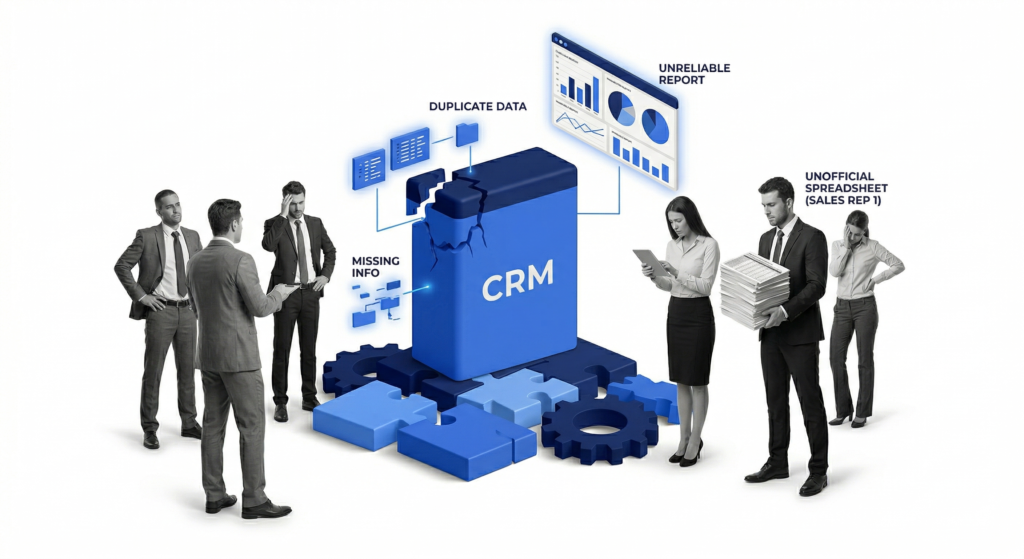
The setup is clean. The workflows run. The contacts are imported. And then six months later, sales still doesn’t trust the lead data. Activities aren’t logging consistently. MQLs coming in from secondary platforms are arriving incomplete, duplicated, or out of sync with what’s already in the system.
The platform isn’t broken. The data model is. HubSpot was configured as a marketing tool and then handed to sales without aligning the underlying data structure to how deals actually move. The automation was built around what HubSpot can do, not around how your team actually closes. The sales cadence exists in someone’s head, or in a separate tool that doesn’t write back to HubSpot.
This is not an edge case. It’s the standard outcome when implementation doesn’t start with a diagnostic of the full pipeline process.
Automation That Fires Without the Right Data Behind It Is Just Scheduled Noise.
Automation Built on Incomplete Data Moves the Wrong Leads the Wrong Way.
HubSpot’s automation capabilities are genuinely powerful. Behavioral triggers, lead scoring, lifecycle stage progression, task assignment, deal creation. The mechanics are solid.
The problem isn’t the automation. It’s what it’s operating on. When MQLs sync in from ad platforms, outbound tools, or third-party sources with inconsistent field values, your lead scores reflect data quality issues, not buying intent. When workflow logic can’t distinguish between a contact actively in a sales conversation and one that went cold six months ago, automation creates noise for your reps instead of clarity.
We build automation that operates on clean, structured data. Lead scoring models that mean something because the underlying contact data is consistent. Workflow logic that reads actual sales stage and rep activity. Lifecycle transitions tied to real deal movement, not just form fills.
Automation that reflects your revenue process.
Leads Don’t Go Cold Because Your Product Is Wrong. They Go Cold Because No One Followed Up at the Right Moment.
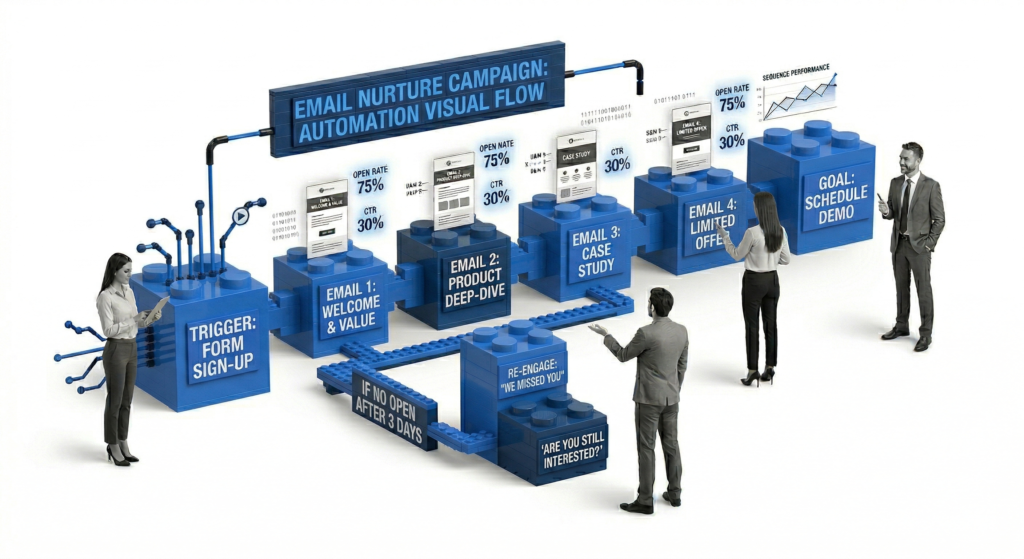
Nurture Sequences That Run Are Not the Same as Nurture Sequences That Work.
Most companies have some form of lead nurturing in place. Email sequences go out. Contacts receive content. Engagement rates look reasonable in the dashboard.
But engagement isn’t pipeline. The question is whether your nurture sequences are actually accelerating decisions, or keeping contacts warm until they buy from someone else. Effective nurturing inside HubSpot requires three things that are rarely in place simultaneously: content mapped to actual buying stage, not assumed interest; triggers connected to sales activity so sequences pause when a rep is actively working a contact; and handoff logic that routes a lead to a human at the exact moment behavior indicates readiness.
We design and build nurture infrastructure that coordinates with your sales process. Not around it.
Your Data Doesn’t Break Inside HubSpot. It Breaks on the Way In.

HubSpot Connected to the Platforms That Actually Drive Your Business.
HubSpot works as your core system when it has complete, accurate data to work with. The integration challenge isn’t connecting HubSpot to a CRM. It’s making sure everything that generates contact and intent data outside HubSpot flows in cleanly and maps correctly.
Ad platforms, outbound prospecting tools, sales engagement platforms, web analytics, event systems. Each one creates contact records, activity data, and engagement signals. When those sync into HubSpot with field conflicts, duplicate records, or missing attribution, the system your sales team is supposed to trust becomes unreliable.
We map the integrations that matter for your specific stack, identify where data breaks down in transit, and build sync logic that keeps HubSpot’s data model clean under real-world conditions.
Before We Configure Anything, We Need to Understand What’s Actually Broken.

We Assess Before We Build. That Prevents the Problems You Already Have from Repeating Themselves.
Every HubSpot engagement starts with a diagnostic. We need to understand what’s connected, what isn’t, and why certain things aren’t working before we recommend a single change.
That means auditing your current configuration, your CRM integration, your automation logic, your data model, and your reporting setup. What we find shapes what we build. Scope defined before a diagnostic is scope that will likely need to be redone.
The diagnostic is a paid engagement. You own the findings whether you hire us for implementation or not. If after the assessment we’re not the right fit, we’ll tell you.